

I see many social media posts with titles like “Master Your Headstand.” Posts and articles like this make it seem like advancing your Yoga practice is about achieving athletic, challenging poses.
Yoga is not about attaining fancy postures like headstands but about the awareness brought to the practice. What do I mean by awareness? Awareness is not thinking about your practice but being present to the sensations created by your practice.
Yoga is a tool to learn to make skillful choices by letting go of the “should” that your ego generates and becoming aware of what you need at that moment.
Recognize the wisdom of your body
Awareness is not overriding the wisdom of your body for ego gratification. You may shut out and override the subtle signals the body attempts to communicate. You may be so in your head that you have lost the ability to connect with the body’s felt sense and wisdom.
Yoga is learning to recognize when you are pushing yourself into an unhealthy place, creating more harm than good.
Yoga often reinforces the tendencies you already have. If you are a type A addictive overachiever personality, Yoga can feed that tendency. Your natural inclination may be to push hard to achieve a pose. Nothing is wrong with achievement, but constantly moving beyond your limits may create exhaustion or illness, or injury over time.
For the overachievers, learning to let go, and let be, might be what is needed. Yoga is realizing you don’t need to force everything, or everything has to be about achievement. The journey and the learning are more important. You don’t need to force yourself to enjoy a gentle class. It means focusing on learning to let go and be with what is, even in a heated vinyasa class. Gracefully letting go of the result is a core principle of Yoga and the hardest for many. For me, it was.
Find your just-right place in a range of possibilities
As I’ve talked about in my last few musings, Yoga is a balancing of opposites. If you are too cold, you need warmth. If you are too warm, you need to cool off. There is the concept of Sthira or Sukkha, effort and stability, versus ease and flexibility. How much effort do you need to apply, and how much is too much? Too much effort creates physical tension, and too much flexibility may mean stretching joints and ligaments. Either way, there is a greater chance of injury.
There is also the Concept of the Gunas, or the three states of mind. Tamas is dull and heavy. Rajas is agitated or excited. The goal is to create Sattva, neither sluggish and heavy nor agitated and restless. Too much dullness needs some excitement to tip the needle toward Sattva. Too much Rajas needs a little grounding Tamas to tip the needle back toward Sattva.
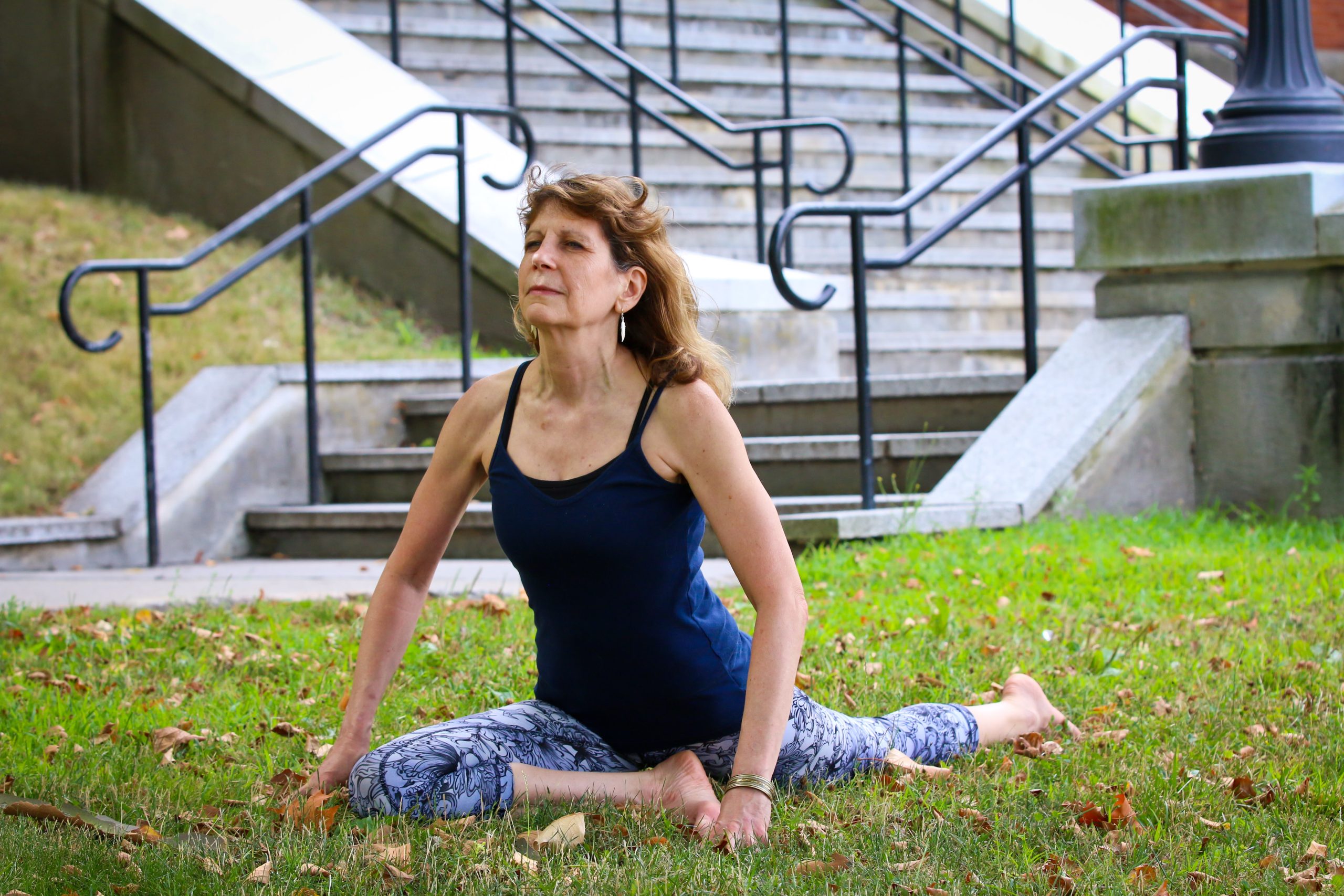
The balance for each individual will be different. The only way to notice what the “just right” point is, is to be aware and observant. What is working in your practice, and what is not? It takes honesty to be what you are, practice for you, and not for someone else.
Stay present in the NOW
Being aware requires being present. Your mind is in the moment, not off in the past or thinking about the future. It helps to anchor your attention to one object. Your anchor might be an awareness of the breath or physical sensations. It might even be a sound. It’s not thinking about your practice, two steps ahead, focused on where you are going; it’s focusing on being in the now.
Whatever happened in the past is only a memory tainted by perception, and the future is not known. If you are insistent on a future that looks a certain way, you miss the opportunities and the possibilities present in the now. You may think a pose needs to express in a certain way, but if you are present through the creation, your outcome may be different and honestly more truthful. What you created yesterday, or last year in your practice, may not be your practice today.
Yoga teaches you to be present during the transitions, those in-between places when you are between poses or between life goals. Yoga is not about reaching a specific destination. Yoga is learning that everything is a journey. One end is another beginning. If you are honest, you might realize that the goal you thought was your destination may not be, and you may change course instead of forcing the end result.
Act without expectation
Yoga is acting without expectation of the outcome. It is applying the action you believe is truthful based on your awareness and then letting go of any expectations about the results. You did the best you could. Nothing more can be done. You then place your attention on the next moment with full awareness and honesty, creating the following truthful action. As a control freak, this is very hard for me to master.
This does not mean giving up on goals. It is being realistic about what is needed to achieve them. It is learning to recognize where you need to take a few steps back or where your expectations may not be based on your current truth. It understands what it is that you really need, not what your ego thinks you need.
You are the witness
Yoga attempts to teach you how to settle your mind. Your mind is not your thoughts. It is the space behind your thoughts. You learn to be the witness, no longer enslaved to your thoughts. It is moving awareness from the head to the heart, not thinking about your practice, feeling it, embodying it. Yoga is learning not to apply good or bad judgments or label the experience. Words are representations of the truth. They are the map, not the territory. Instead of placing awareness on the words or judging your practice, Yoga focuses on what is being felt in the moment.
Everything changes
Yoga is realizing that everything changes. Nothing stays the same. You can’t expect to have the same practice each day, and over time your practice will change. The only way to grow and adapt is to be aware of what is changing, adjusting your just right place.
Your practice is unique
Most yoga poses are not meant for everybody, yet we have expectations of achieving them, even if it means potentially hurting ourselves. Many poses can only be achieved by the hypermobile Yogi. Even then, this may create joint compression and damage over time.
Postural Yoga was meant to be a step toward practicing meditation, learning to separate the thoughts, emotions, senses, and distractions from the witness underneath. This process begins by embodying your practice, not denying the truth of what is being felt.
What is a Yoga practice?
Yoga is being fully present in each moment, aware of the truth. It is applying the balance of opposites and finding your just right place on a spectrum of possibilities.
Yoga is action without expectation of the results of your actions. Yoga understands that everything changes, no two practices will be the same, and your practice will evolve over time.
Yoga takes you beyond your mind, working toward the felt sense and wisdom within your body. It is finding the witness beneath thought and emotion.
Yoga is not about getting into a handstand but understanding why you want to create this pose and whether it works for you now or ever.
Yoga is taking these concepts off the mat. How present and aware can you be in each moment, not just while on your Yoga mat? Yoga does not require any specific pose or even a postural practice, although movement is a form of anchoring your mind.

0 Comments