
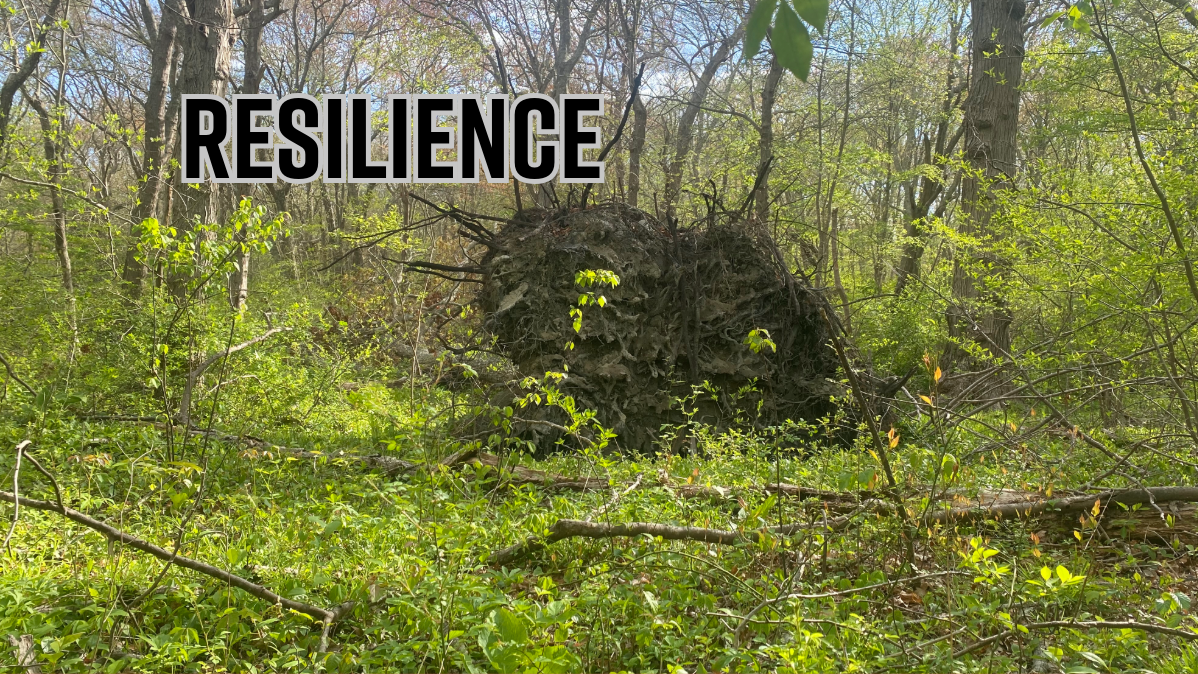

If there were one trait needed right now, resilience would be at the top of my list. What was once “normal” may no longer exist. The solid ground of the known has given way to the shifting sands of the unknown. I have an image of the Bozo Bop Bag I had as a kid. He gets whacked and keeps coming up for more, still grinning.
The dictionary defines resilience as the ability of an object to spring back into shape. It gets pulled and tugged but is elastic enough to reform. Resilience is to bend but not break, getting knocked down but still rooted.
Heavy oak trees may break because they are heavy and rooted but don’t bend. Light and fibrous palm trees sway in the wind. Resilience is a balance of staying grounded yet giving way. It is a dance between opposites.
Sthira/Sukkha
Yoga gives us the concept of Sthira, structure, and Sukkha, ease, mobility, and elasticity. These terms were used to describe the first Yoga Asana, pose, the meditation seat, and the seat itself. It should be grounded and rooted yet easeful, allowing the spine to stack above the seat with little muscular effort. There is a point of balance between structure and mobility. This balance shifts and changes with the situation.
Your body is a miraculous blend of Sthira/Sukkha. Your bones provide stability and structure, and your joints and muscles provide mobility. As a result, you can bend and move and stay within your human form. If you were engineered only for Sthira, a strong structure with little movement, you would be an immobile column of bone. If you were engineered only for mobility, you could not stand tall.
The principles of Sthira/Sukkha apply to all aspects of life, both on and off the yoga mat. On the mat, you can explore the range of motion in each pose. Yoga is not all about flexibility. Yoga, in reality, is finding the balance between stability in a posture and flexibility. How much mobility is enough without compromising your structure? The practice may be more about creating stability for some yogis, especially hypermobile people. Yoga is finding the just-right place, the middle ground in a range of opposites.
Resilience – the balance of opposites
You can take these principles off the mat and into your life. When do you stay in place, stick to the known and predictable, and when do you create change? Where is the balance between too much and not enough? Where do you give too much, or where do you hold back?
When you create a yoga pose, a shape, you can turn your awareness to the sensations the posture creates. You learn to tune into the truth of the moment, the reality of what serves you. You learn to choose the balance of effort or release. When do you hang on, and when do you let go? Are you forcing a shape because your ego believes you should? Are you holding your breath? You can learn to seek the just-right place of enough effort, support, or Sthira in your pose, ease, the flow of breath, and freedom in the joints, not gripping or forcing.
Yoga, on or off the mat, allows you to explore resilience. As you create your unique pose expressions, you find the edges, the places where you bend and soften, and the places where you stand your ground. Then, finally, you move to the just-right center of opposites. You may sway and even fall, but you always have the choice of getting back up and trying something different.
Maybe even with a smile.

0 Comments