Introduction to Ayurveda (Part 2) – Create Balance

Introduction to Ayurveda (Part 2) – Create Balance

Introduction to Ayurveda – Part 2

In the first lesson, I introduced the basic building blocks of Ayurveda, the five elements; Ether, Air, Water, Fire, and Earth. Everything in creation contains a unique mixture of these five elements in the form of the Doshas elements.

The Doshas are energetic principles that are combinations of the five elements. Therefore, we all have a unique blueprint based on the combination of the doshas, with generally one predominant Dosha, or energetic quality.

Each Dosha has characteristics or qualities and functions they serve.

Vata, the combination of Ether and Air, is the lightest and most mobile. Its qualities are Dry, Light, Cold, Rough, Moving, Subtle, Coarse.

Pitta is the combination of Water and Fire and is flow and heat. Its qualities are slightly oily, light, hot, sharp, flowing, liquid, pungent.

Kapha is the combination of Water and Earth and is the most solid and heaviest of the Doshas. Its qualities are oily, heavy, cool, slow, dull, sticky, stable.

Like Increases Like

A fundamental rule of balance in Ayurveda is like increases like. Qualities similar to those of a Dosha will increase the Dosha. Applying the opposite will decrease the Dosha. In cases where there is an imbalance in the Dosha or even dis-ease process, this concept can help regain physical and mental balance and health.

The Universal Pharmacy and the twenty attributes 

The twenty attributes are ten pairs of opposites that describe the qualities of everything in nature. For example, balance can be created by applying similar qualities as a Dosha for deficiency and more of the opposite for excess.
For example, if someone physically has an excess of Kapha and is trying to lose weight, they can use the principle to decide what foods to eat. Kapha is heavy, dense, oily, and cool. Eating cheesecake that is heavy, dense, and oily will not help. Instead, eating something that has the opposite qualities will decrease Kapha. Instead, they might choose warm, lighter baked apples. Someone who has excess Vata and tends to lose weight would benefit from a more grounding diet of warm cooked foods with some oils. A light salad would create more imbalance. Kapha needs more movement because Kapha resists movement, whereas Vata may benefit from a gentler form of exercise. Excess of Pitta heat can be countered by cooling down physically and with cooling foods like cucumber.

The Six Tastes
Tastes and spices are also ways to work with imbalances. You can use spices to help balance the doshas. Add a spice mix to food to increase the specific qualities. The Six tastes should be present in every meal to satisfy cravings. Reducing tastes that may aggravate the Dosha or adding tastes that pacify a deficient dosha may be necessary if a dosha is out of balance.

Sweet: Earth + Water Found in meats, grains, bread, pasta, potatoes, milk, and desserts. This Taste increases Kapha and decreases Vata and Pitta.
Sour: Earth + Fire Found in yogurt, cheeses, citrus fruit. Increases Kapha and Pitta and Decreases Vata.
Salty: Fire + Water Found in all salts and sea vegetables. Increases Kapha and Pitta and decreases Vata.
Bitter: Air + Ether Found in Salad greens, bitter roots, and bitter tea. Increases Vata and decreases Kapha and Pitta.
Pungent: Air + Fire Found in many spices and herbs. Increases Vata and Pitta and decreases Kapha.
Astringent: Air + Earth Found in beans, broccoli, rhubarb, raw vegetables, and raw apples. Increases Vata and decreases Pitta and Kapha.

Doshic Cycles

The balance of the Doshas will change based on the time of day, the season, the stage of life, your location.

The Times of Day
Different times of day are considered to have more of the qualities of one of the Doshas.

Kapha Time 6 am to10 am and 6 pm to 10 pm
 It is good to get out of bed before Kapha time. During Kapha time, there may be lethargy, and you will end up sleeping in and feeling dull when you get up. On the other hand, getting to bed and falling asleep during Kapha time uses inertia that may help you fall asleep. In addition, Kapha time is a great time to exercise in the morning, offsetting the dullness.
Pitta Time 10 am to 2 pm, and 10 pm to 2 am
At noon, digestion is the greatest. Eating the most significant meal at lunch is good practice to digest and assimilate your food thoroughly. Staying awake into Pitta time at night may give you a second wind.
Vata Time 2 pm to 6 pm and 2 am to 6 am
Vata time is the best time for mental activities. In addition, Vata time at night is often where the most dreams happen.
The seasons affect the Doshas.
There are four seasons here in New England, but Ayurveda looks at three seasons. So, depending on your location, you may be more or less affected by the seasons.
Autumn is dry and cool, like Vata.
Winter is wet and Cold, like Kapha.
Summer is hot and moist, like Pitta.
You may need to adjust your foods and lifestyle during a season to maintain balance. For example, you would probably not want to eat ice cream in the middle of winter in New England, but that would balance the heat in the summer.
Stages of Life

Each of the stages of your life will affect balancing the Doshas and balancing the Doshas. For example, a lifestyle that works for someone in their childhood may not work in adulthood or senior years.

The Kapha stage is your early years, from infancy to late teens. During this time, physical and mental growth forms your bones and body. Kapha time is when you are in school.
The Pitta stage is the time of most ambition and effort. It is when most people are working and raising a family.
The Vata stage is the senior years of your life. Vata time is when your body starts to age and lose its Kapha or stability and moisture.


This  video is about 25 minutes long.  If you have any questions, please reach out to me [email protected]


Here are links to Part 1 – an introduction to Ayurveda and the third video in the series, The 3 Imperatives.

Enjoy!

Intro to Ayurveda – Part 1

Intro to Ayurveda – Part 3

Introduction to Ayurveda (Part 1) – What is Ayurveda?

Introduction to Ayurveda (Part 1) – What is Ayurveda?

Introduction to Ayurveda – Part 1

Ayurveda is the science of life or the knowledge of life. It is an ancient, traditional form of holistic medicine that shares its roots with Yoga. It defines health as more than the absence of disease. Health is a balance of body, mind, and spirit. It taps into the intelligence of nature, the nature that exists in every cell of your body.

Ayurveda is more than following rules. It helps you apply self-knowledge and self-awareness to bring you into balance. Ayurveda is living in harmony with the natural world around you. It accesses wisdom in every cell of your body, and learning to use this intelligence to create wellness. 

Your Unique Blueprint 

Each of us has a unique blueprint, known as your constitution, or Prakriti, in Sanskrit.
Your constitution is a unique combination of the five elements that are the building blocks of everything around you, including your body and mind.
You are unique. You have a unique physical and mental constitution, expression, and purpose. As you move away from alignment with your unique blueprint, this opens the door to dis-ease.

Ayurveda gives you a guidebook

Ayurveda guides lifestyle choices that best support your uniqueness. These guidelines support aligning with your true nature, body, mind, and soul. These are not rulesets but help you maintain balance through changing states of health, different stages of your life, seasons, location, and even the time of day.

The Basic Building Blocks: The Five Elements 

All animate and inanimate objects in the universe are composed of these five elements and their corresponding energy and attributes, Ether (space), Air, Fire, Water, and Earth.


Ether (Akasha)

Ether, space, is immobile and light because it contains nothing. It is the dark, cold space the other elements fill. It is the most subtle element.

Air (Vayu)

Air arose from the movement of Ether. Air has the qualities of being subtle and mobile. It is light like Ether, clear, dry, and rough. It represents movement.

Fire (Tejas)

Fire evolved as the movement of air created friction and heat. Fire is heat and light. It flows and is clear, soft, and dry. Fire gives vision and clarity, the light we see, and heat for transformation.

Water (Apas)

As fire became denser and began to cool, water was created. Water is cool, heavier than fire, moist, and smooth. Water is flow, including emotional flow.

Earth (Prithivi)

Earth is the most solid and stable element. It evolved as water became denser. It is heavy and solid. It is the grossest and densest of the elements. It provides stability and resistance to movement.

The Doshas 

The three Doshas are energetic principles that are combinations of the five elements. The Doshas are present to some degree in all of creation. No Dosha is better than another. Each Dosha has essential attributes.

Vata

Vata combines Ether and air and combines their qualities of light, dry, coarse, changeable, and moveable. Vata governs movement, transportation, communication, and the nervous system from its seat in the colon. Vata’s predominant individuals are the lightest, moving and speaking quickly. Vata individuals tend to have variable sleep and appetite and are talkative and enthusiastic when balanced.

Pitta

Pitta is the combination of Fire and Water and contains the qualities of both. It is hot and intense but also soft and flowing. It governs transformation and digestion. The seat of Pitta is in the Small Intestine. Pitta’s physical types are of medium build. They are intense and goal-oriented and generous when balanced.

Kapha

Kapha is the combination of Earth and Water. It is the most stable Dosha and is responsible for strength, immunity, and lubrication. The Kapha physical type is the largest build and the most muscular. They are sweet, loving, and loyal when in balance.

Why is Ayurveda still relevant? 

Humans are distanced from nature and our true nature more than ever. We no longer recognize or listen to the innate wisdom within ourselves. We are out of balance, stressed out, eating foods that don’t nourish us, overconsuming food, and sensory input. As a result, we are not grounded, not connected. We have lost the understanding of the beauty of our unique blueprint, our unique beauty, talent, and contributions.

Introduction to Ayurveda Video

This introductory video is about 17 minutes long.  If you have any questions, please reach out to me [email protected]

If you are interested in your dosha type, here is a link to a Dosha quiz:

Mapi.com Dosha Quiz


Here are links to the following videos in the series, Part 2 – Find Balance and Part 3 – The three Imperatives.

Enjoy!

Intro to Ayurveda – Part 2

Intro to Ayurveda – Part 3

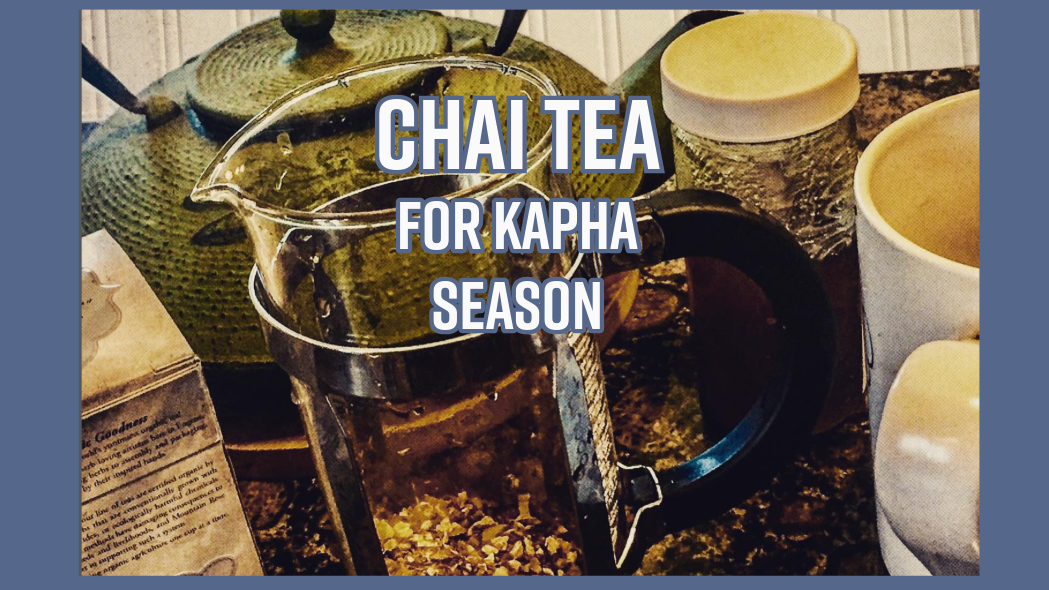
Chai tea for Kapha Season

Chai tea for Kapha Season

Spring is Kapha season.  It is a time of damp, chilly weather here in New England.  Ayurveda teaches that to balance Kapha, we need to apply the opposites, something with heat to dispel the damp.  The perfect antidote to this is a hot spiced chai tea.  If you would like a caffeinated version, you can add a teaspoon of black tea.  I place the herbs in a tea infuser and set this into the boiling water.  You may choose to substitute Nut or coconut milk in place of dairy milk.

Chai Tea

2 cups of water

1 cup of your choice of whole milk or plant-based milk

1 tsp Fennel

1 tsp Coriander

About a tsp of sliced Ginger root

About a tsp of crumbled Cinnamon bark

3-4 crushed cardamom pods

2 Cloves

2 Peppercorns

Boil the water and immerse the herbs in a tea infuser into the water simmering for about 15 minutes.  Add the milk and cook for another 5 minutes to heat the milk.  Sweeten to taste with honey or maple syrup.

Enjoy!