Anchor Your Mind

Anchor Your Mind

Anchor your Mind

For a new meditator, the hardest part is focusing your attention and not getting lost in distractions like your thoughts or distractions around you.  Meditation starts with training the brain to concentrate or focus on one object.  The breath is often used because it can be both felt and heard.   The reason for creating an anchor is to keep your mind from getting lost in every thought and sense object that pops up as you sit.

The object you choose becomes your anchor.  As you notice you have lost attention on your anchor, gently guide your way back to it.  The practice is to learn to recognize when you have lost focus.

Don’t feel frustrated if your mind continues to wander.  That is the nature of your mind.  Keep practicing returning to your anchor.  Over time your brain will begin to stay focused longer and longer.

You can practice by sitting comfortably and bringing your attention to either the sound of your breath or the sensations in your body created by your breath.  You might notice your belly or ribcage moving or feel breath on your mouth or nostrils.  You only need to sit for a few minutes to start your practice.

In this guided audio, I lead a very short meditation using your body and your breath as your anchor.


Find Focus – Anchor Your Mind Guided Audio

 In this six-minute video, I  lead you through a short meditation using your breath as an anchor.

Practice Tips – Sit comfortably or lie on your back for the meditation.  Close your eyes or drop your gaze just in front of you, so you limit visual distractions.

Pick an anchor.  It might be the sound or sensation of your breath or another sense stimulus like noticing your seat or back where you meet the surface of the floor or chair.

Remember, the goal of the practice is to notice when you have lost attention and gently guide your attention back to your anchor.  This is a practice, it may take time to train your brain, but it will happen!

Enjoy!


Meditation – Launch your practice

Meditation – Launch your practice

Tips for launching your meditation practice

Meditation has many benefits, a calmer mind, a sense of ease, and less reactivity to events. But, to gain the benefits of meditation, you must have a consistent meditation practice.
The biggest challenges I see for meditators are starting, then creating a habit. For some meditators, it is finding their way back to their practice.
 
Four tips to get started or get back to practice!
 
  1. Step one is to ditch the distractions and find five minutes in your day to meditate. Five minutes is enough to start this new habit and break the cycle of stress.
  2. Then, sit comfortably, and use a sense object to focus your mind. This object used to anchor your mind might be feeling and hearing your breath. Don’t worry if your mind is active. Keep refocusing on your object.
  3. Don’t sit too long to start; don’t worry if your mind is busy. The goal is not to stop your thoughts. As you start, you are learning to focus your mind.
  4. Bring your sense of humor, and remember, anyone can meditate!
6 Steps to Create a Meditation Practice

6 Steps to Create a Meditation Practice

I want to offer six simple steps to create a lasting meditation practice in this musing.

What is a meditation practice?

By meditation practice, I mean, hopefully, a daily practice, first seated. You may find your practice becomes a part of your day.  

Meditation needs to become a habit that is part of your routine. You need to stay committed. Commitment means sitting even when you don’t feel like sitting.

Start with a clear intention of why you want to meditate. Are you looking for more clarity or a calmer, less reactive mind? Remind yourself of the benefits of practicing when you feel you would rather skip the practice.

Step 1 – Find a Consistent Time and Place

It helps if you meditate consistently to benefit from a calmer, clearer mind, less stress, and greater awareness of your inner workings and environment. Try to set up a consistent routine of meditating daily. Create an appointment in your calendar. Find a time that can be consistent and when you will be the least likely to be interrupted or stressed. Set a phone alarm if you need to. I like early mornings before my day gets away from me. Maybe you consider getting up ten minutes earlier or hitting the snooze alarm one less time.

Once you have a time that works for you, find a place that works for you. A consistent place makes coming to your time and place a habit. This may be a corner of a bedroom or a spare room. If possible, pick a location that does not remind you of the thousand things you should be doing, like an office room. Prepare for meditation by setting up your space and clearing any clutter that might distract you.  


You may choose to get a notebook to journal your practices. If you are journaling, have your notebook nearby when you meditate. You may choose to write your intention in your notebook. This intention may change over time or with each meditation. Your journal entry may be as simple as noting the day, the time, and a few words about your experience like sleepy or agitated. Over time this will help you notice any patterns and help track your progress.

Step 2 – Clear the distractions and get comfortable

Sit at your scheduled time in your chosen space. Turn off your cell phone, email, or any other digital distractions. Close the door if you need to keep family or coworkers out. Let everyone know that you need a few minutes uninterrupted. Sit as comfortably as you can. It may be in a chair with your feet touching the floor or a book. It might be on the floor sitting on a blanket or pillow to allow your hips to be higher than your knees. Make sure your seat is comfortable and does not create tension. Keep a blanket nearby if you get cold during practice. Remind yourself of your intention, why you choose to practice.

The first few times you practice, make sure this is a time when you are not tired, distracted, or hungry. Suppose you are disrupted during your practice by noise or other people. Is there a way to eliminate the distractions or find another place? Maybe another time would work better?

Step 3 – Start small

Start by sitting for only five minutes or less, maybe eventually ten minutes. Sitting too long at first may be frustrating and harder to keep in your schedule. It is better to get into the habit of sitting by making it as easy on yourself as possible. As time goes by, you may increase the sessions by a minute or a few minutes at a time.  

Step 4 – Choose your meditation

You may choose a guided meditation or sit with a pre-chosen object like your breath. You may have already experienced a guided meditation on the breath. There are other objects you can use as a focus or anchor. The breath is the most accessible because our breath shifts with each inhale and exhale, and you can feel or sense it at some point in the cycle. Breath can also help calm the mind. When the breath slows, the mind tends to slow. You may meditate on a sensation in your body or another sense, like sound, or gaze at an object or candle.


Once you begin to notice all the different objects you can use, you can choose to meditate anytime and anywhere.

You might take a few deep focused breaths during your day to calm yourself or gain clarity. You can meditate in line at a checkout, maybe focusing on your breath or the noises around you. You can offer loving kindness to someone challenging in your life, or even yourself.  

If you decide to meditate without a guided audio, there are meditation timers or apps that will keep track of the time for you. An oven timer will work just fine.

 Sit for the time you decided, even if you feel distracted or unproductive.


Step 5 Let go of expectations

Bring your sense of humor, and be prepared to be with whatever your mind throws at you. You will have a different experience in each meditation. Don’t try to force out the thoughts. You can’t stop them. Acknowledge the thoughts that come up and move back to focusing on your object of meditation. Meditation does not need to feel peaceful and blissed out for it to be effective. It is a practice, have patience, and be prepared to laugh at whatever comes up as you sit.


Step 6 – Stay with it

Starting a meditation practice is not easy. Remember, you are training your brain to focus. If your mind has been running 100 miles per hour for years, it won’t be easy to train it to slow down. There will be practices where you won’t feel like you accomplished anything, the practice was restless, or you couldn’t focus. That’s ok. Stay with it. Know that even during the not so blissful practices, you are still gaining a benefit, working toward your intention. Meditation takes time. Meditation takes patience.  

Find your seat, and enjoy.


Interested in trying out a guided audio meditation?  Click on the link below.

Guided Audio Meditation – The Breath


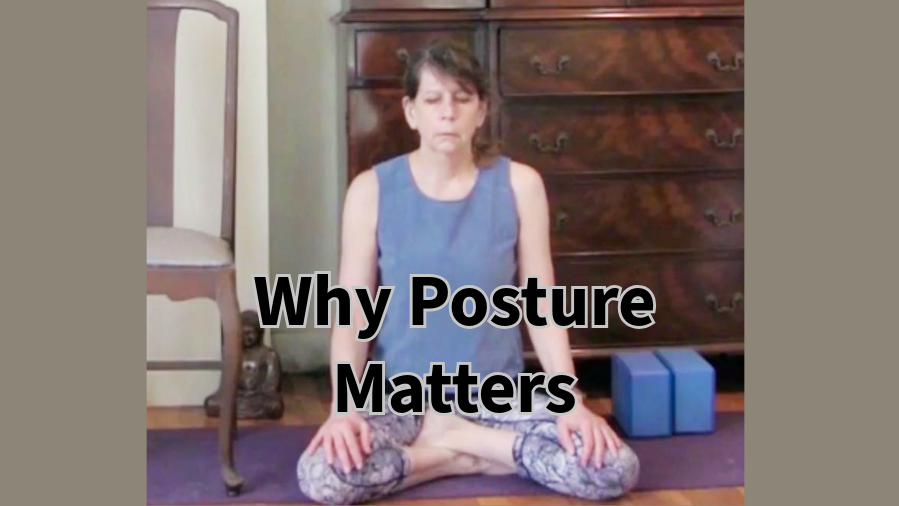
Meditation – Why Posture Matters

Meditation – Why Posture Matters

How you sit determines how successful your Meditation practice will be. The goal of the meditation seat is to keep you awake and alert but relaxed. You need to be comfortable but not so comfortable that you fall asleep. However, if you need sleep, take a nap instead of meditating!

You need to find a seat to hold for the length of your meditation without pain or tension.  If you force yourself to sit upright, you create tension in the physical body. This tension causes the Central nervous system to remain engaged, making it more challenging to move from thought.

If you are not comfortable, your attention will be on the discomfort. 

If you are tense and rigid in your body, you block out sensation and keep your mind engaged. When you align yourself physically in an easeful way, you align with gravity, with the earth that supports you and the energy of everything around you. You get out of your head and into awareness.  

You don’t need to sit in a cross-legged position on the ground to meditate. You may sit in a chair or even lie on your back if that is most comfortable for you.  

If you are seated, your spine and body should align in a way that does not create tension and requires little effort.  You allow gravity to work for you, not against you.

You may need to support yourself with props like a blanket or a cushion to keep your spine aligned.  Have some pillows, blankets, and yoga blocks or books near you as you experiment with creating your meditation seat.


Setting up your Meditation seat


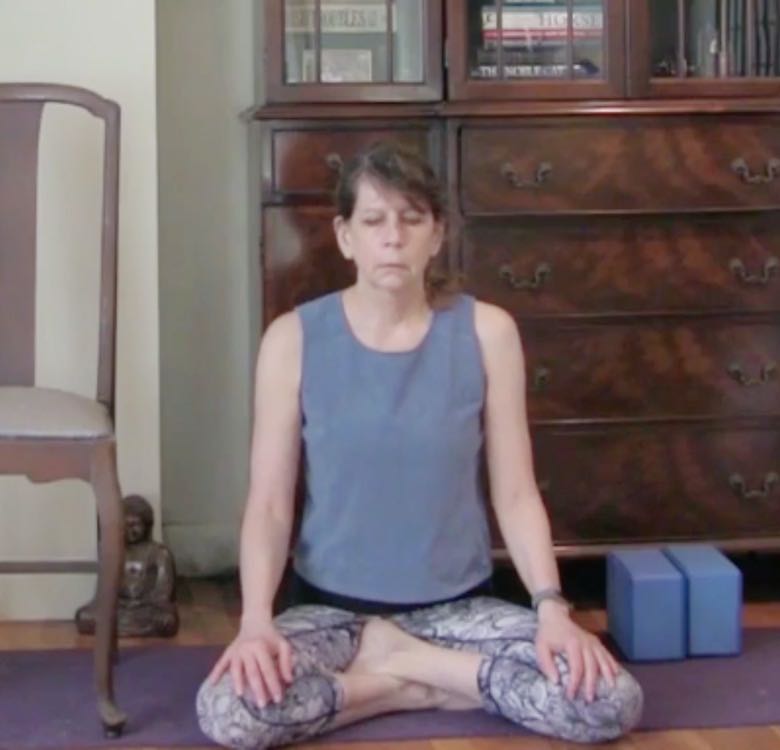
You may choose to sit with crossed legs on the floor in an easy seat, one foot in front of the other.  You may need a folded blanket or couch cushion under your seat to raise your hips off the floor.


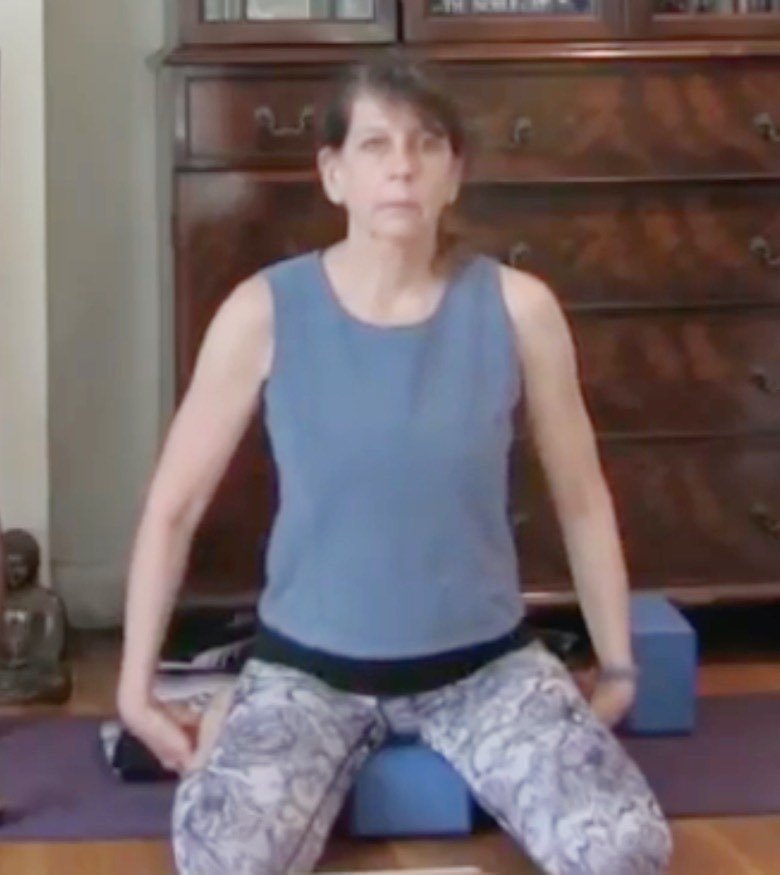
Another option is to sit in a sage position with your legs behind you. You may be sitting on a couple of books or a yoga block.  A rolled towel or blanket may support your ankles. 


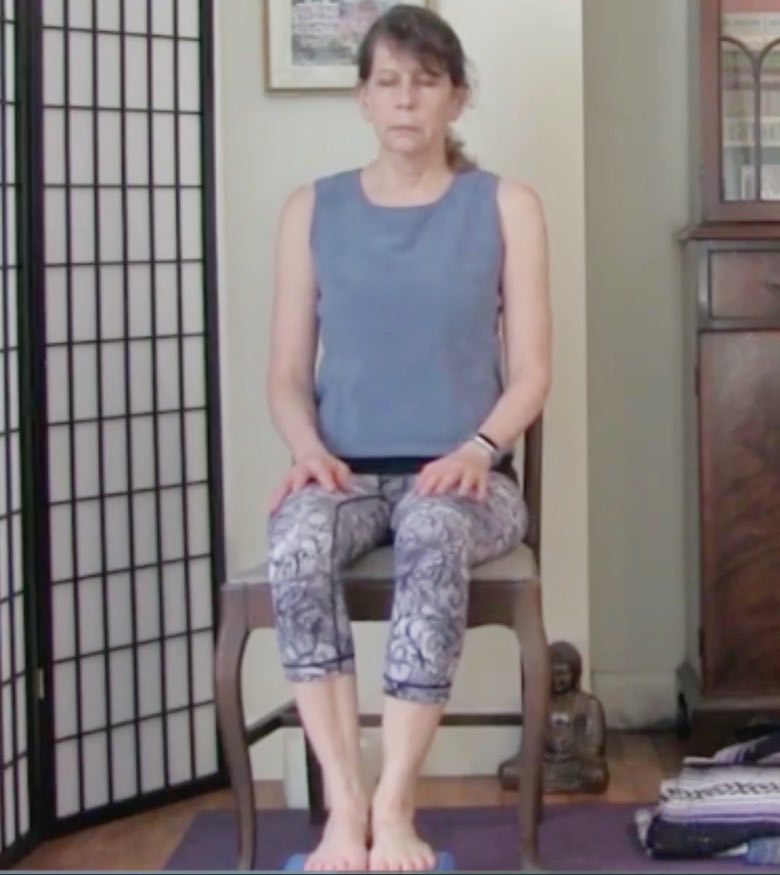
You might choose to sit in a chair with your feet resting on the floor. If your feet aren’t reaching the floor, place a book or two underneath them for support.

Once you have settled into the way you want to sit, allow your spine to lengthen from your seat to your head, not slumping and not forcing yourself upright. 


Your seat starts by creating a stable base from your legs and hips

Your hips should be higher than your knees in a seated position, allowing the pelvis to tip forward slightly.   When the pelvis tips backward, the low back rounds, the trunk moves forward. In that case, the front of the upper body compresses, including the lungs, making breathing more difficult. This also drops the head toward the lap. Sitting too far forward on the cushion causes the low back to hollow or arch. As you sit, imagine a line running up the center of your torso. Attempt to arrange your spine along this line. Sitting on a cushion can help raise the hips. Experiment with different blanket heights to see what works. 

Imagine one vertebra stacking on top of the other. Your lower back should not be rounding. Your shoulders are not slouching. Readjust your seat if you need to. Remember, good posture starts from your seat.   

The shoulders and arms are relaxed.  Your arms hang loosely at your sides with even shoulders. The hands may rest on your thighs or be in your lap.  

The head centers over your neck. Don’t let your chin drop to your chest. If your eyes were open, you would be looking ahead. The head weighs around ten pounds, so if it is too far in front of you, your neck will be straining to keep it from dropping forward.

Your eyes may be closed, or you might look just in front of you with a soft gaze.

Unclench the jaw, leave some room between the teeth. Imagine softening your lips, cheeks, and forehead.


If you feel tense, try moving

Shrug your shoulders, relax your jaw, and wiggle your fingers or toes.

Create any movement that helps release tension. If you still feel tense, try adjusting how you sit and adding more height under your seat. 

If you are in a cool place, have a blanket ready to wrap around you. Sitting still will drop the body temperature. Also, being cold will create tension.

Experiment with different ways of sitting and using pillows and blankets.

See what works best for you.


Find your center

Once you feel like you have found your stable but relaxed seat, begin to add some movement, gently swaying your head and torso from side to side. Keep the swaying soft and gentle. Imagine the movement is starting at the pelvis, and the spine sways above your seat.  

Shift your upper body to the left and notice how the right hip wants to lift to keep you balanced. Take a breath or two as far to the left as is comfortable, then come back to the center and then begin to move your upper body over to the right. Notice the left hip working to anchor you to your seat. Come back to center, and then begin to move from right to left, noticing how far over you can move, notice any sensation in your body. The sensations may increase as you move further to one side and decrease as you move back toward the center.

Allow the movements to become smaller and smaller until you’re back to the center. Once you are back to the center, take a moment to notice if you feel like you are leaning to one side or one hip is working to keep you centered.  Make any adjustments you need to keep both hips level and the spine upright.

Start to rock forward and back, starting the movement with the pelvis. Imagine your sit bones move back toward your chair or cushion as if your pockets move towards the chair. As you move your tailbone toward the seat, you may notice the spine shift as the lower back rounds, the chest and head drop forward. Now, imagine lifting your pockets from your seat. You may feel the back body engage, especially the lower back, as your sitting bones move away from the cushion. The lower back curve flattens or even moves toward an arch. Take a few breaths moving back and forth between the two positions.  Drop your pockets toward the seat, let the spine round forward, and then lift your pockets from the seat, lengthening your spine. Keep a steady breath, and don’t force any movement. You may be making small, subtle movements. Eventually, decrease your movement, and work your way back to the center.  

Bring your awareness back to your seat and then your spine. Notice the stacking of one vertebra over the other. Take a moment imagining the downward movement of your tailbone and sit boned toward the seat and the upward moving of the stacked spine.  If you feel like your spine is rounded or your back is tense, play with adjusting the pelvis sitting further back or further forward to find a neutral spine.


Observe

Try sitting for a few minutes, testing out your seat. If you begin to feel tense, you can adjust or create movement. Use the movement as your object of meditation.

Each time you come to your seat, you may have a different experience. So with each practice, bring awareness to your seat and spine. The act of bringing awareness to sensations in your physical body is a meditation in itself.


Drop an Anchor

Drop an Anchor

Meditation trains the mind to be present in the here and now. But, the untrained mind can be a massive barrier to successfully getting through your first five minutes of Meditation.  Your mind, by nature, wanders. It defaults to anywhere but the here and now. 

Sitting and trying to be aware with a flood of thoughts and senses, to-do lists, and random conversations in your head can be like watching a clown car unpack. There is way more stuff there than you ever imagined, and now you are being forced to sit with it and watch the show until the timer goes off. Watching your untamed mind can be overwhelming and scary.

When your brain is not focused on an object or task, it uses the Default Mode Network network network (DMN). The DMN is a continuously active network of brain regions. The DMN allows your brain to remember and plan for the future, but it can keep you out of the present. When you focus on a specific object or task like recognizing a face or remembering a telephone number, this default mode is quiet. It’s called the default mode because unless the brain is engaged, it wanders. The more time it spends in the default mode, the harder it is to keep your mind focused. 


Anchor Your Mind

To keep your mind present, you need an anchor. An anchor is an object that you examine during Meditation. Using an anchor focuses your attention on one thing instead of trying to pay attention to every sensation that distracts your mind.

Objects of Meditation can be almost anything. Traditional practices often use the breath, sensations in the body, or a sound or spoken word or phrase. 

Your anchor is the rope that ties your mind to the present moment. As you focus on your object, this itself causes the Default mode network to quiet, even though you may not notice at first.

Imagine a boat tied to an anchor. The boat starts to drift away from the anchor. The anchor keeps it from going too far. The boat might rise at high tide away from the anchor and sink back at low tide. There’s a dance between the boat and the anchor held fast by the rope that keeps the boat from drifting off completely.  Your mental anchor is similar. 

There will be times when your mind drifts off.  You forget about your anchor.  As you realize you’ve gone off onto another shopping list or a mental conversation with a family member, you allow your attention to come back to your anchor.

When your mind wanders, focus on the breath or your choice of an anchor. Be prepared to return to your anchor as your mind wanders. Your entire practice may be guiding your mind back to your object, over and over.  A wandering mind doesn’t mean your practice is a failure. It means your brain needs more training. Your default mode network is still active. It takes time to overcome the existing mental patterns. Have faith that in time your mind will settle. When I first started meditating, I didn’t think I would ever make more than five minutes of sitting with a restless mind. 

Concentration and Awareness

With repeated effort, you can develop focus and work more with the subtler practice of awareness.

Meditation is not stopping your mind but bringing awareness to the moment, seeing things as they are, unfiltered by your pre-programmed perceptions.  Meditation is a balance between focus, keeping your mind from running away, and awareness of your experiences. It takes more focus as a new meditator. As you find this balance, you begin to integrate the left half of the brain, focused and concentrated, and the right half of your brain, which feels intuitively beyond words. 

With time concentration improves, and there will be more emphasis on awareness.  Awareness is the ability to notice object qualities. If you cannot keep your attention on the object, it will be more challenging to see its qualities.

You may feel the sensation of the breath shifting between the inhale and the exhale. You may hear sounds getting louder or softer. You may focus on a feeling in the body and be a little curious about it. 

What are you feeling? Where are you feeling it, and where do you feel the sensation?

You become the observer.

Be the Observer

The observer’s goal is not to think about the object but to experience your anchor’s subtle shifts and changes. Sensations come and go; they ebb and flow. Thoughts and emotions pop up and eventually drift away.  

Don’t judge the object or experience as good or bad. If you use your breath as an object, notice the sensations as the breath moves and shifts. Be a little curious about what you are feeling, what is moving, how is it moving or shifting? If you use a sound for your anchor, you may notice the sound shifts in some way, getting louder or softer. Does the sound have a shape? Does it seem to be coming from one side or all around you? Does the pitch change?  Just observe and notice.

Like any practice, it takes time to develop a meditation practice. Have patience, have faith.  Drop your anchor, and be prepared to watch the show.