Yoga and the Myth of Flexibility

Yoga and the Myth of Flexibility

Let’s talk about Yoga and the myth of flexibility.

Do you need to be flexible to do Yoga?
Based on almost all Yoga social media pictures, the answer would appear to be ‘Yes”.
Only a tiny percentage of the human population, roughly 10 to 20%, has the flexibility to achieve many of the poses. And they are doing that at the expense of their joints. Too much mobility in the joints can lead to bone-on-bone compression and eventually wearing away of the protective joint cartilage.

Yoga is accessible to the average body or anybody with a breath. Your shape might not resemble the Instagram-perfect pose, but that isn’t even the purpose. It doesn’t matter if you ever get there. It’s about the breath. It’s about exploration. It’s about the movement itself.

Do you feel like the tin man in the back of a class full of bendy, twisty beings from another planet? Don’t be intimidated. You have an average human body like the other 80% of humans. Find a class or teacher that understands and allows you to explore your unique practice.

Don’t feel pressured to achieve. Breathe and enjoy!

Yoga Pose Makeover – Warrior 1

Yoga Pose Makeover – Warrior 1

In this Video, I realign Warrior 1. Warrior 1 is a familiar pose in many Yoga practices, but squaring the hips toward the front of the mat may be difficult or painful for many practitioners.

Widening the feet across the mat’s width and not forcing the back hip to “square” to the front of the mat can help create space in the hip and SI joints.

To try a short practice built around Warrior 1, check out my post, Yoga Practices – Warrior 1 realigned.


Yoga Pose Makeover – Forward Fold

Yoga Pose Makeover – Forward Fold

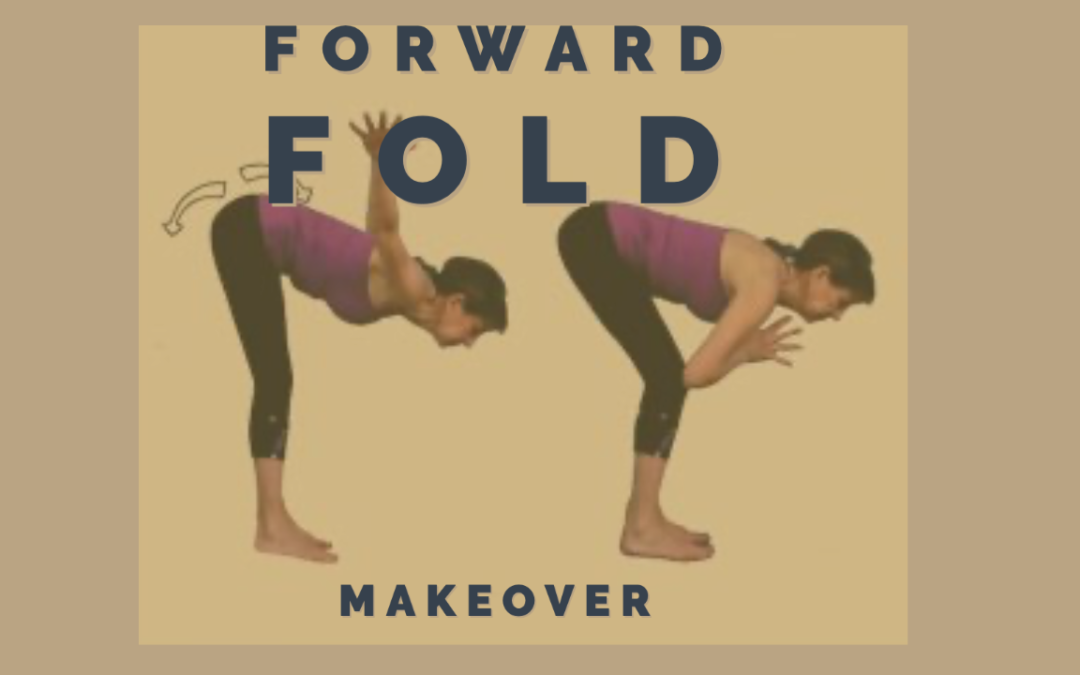
Uttansana (Standing Forward Fold) is a standard yoga pose, often repeated several times in a class. Repeated many times during a class, it can create issues in the SI joint (where the pelvis halves meet the spine) or lower back. Personally, I no longer “swan dive” into this pose with outstretched arms and straight legs. I no longer teach it this way. This post will explain why Forward Folds may be problematic and ways to realign this pose.

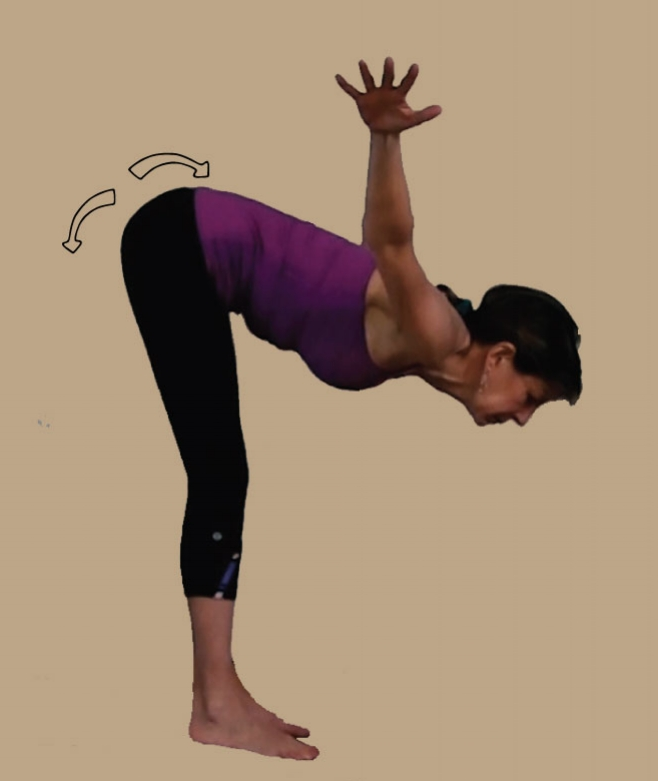
The Forward Fold “Swan Dive”

In this first picture, I am folding forward with straight legs creating a shearing force on the sacroiliac joint (the joint where the two halves of the pelvis meet the sacrum at the base of the spine). The hamstrings act as pulleys, pulling the pelvis down and back. In contrast, the spine’s weight pulls the sacrum forward and away from the pelvis in the opposite direction. Arms out to the sides will add more to this shearing force. If the hamstrings (muscles on the back of the thigh) are tight, more pressure is exerted on the SI joint because there is no slack on the “pulley.”
Tightness on the back body, including the hamstrings, may also cause the back and shoulders to round forward. This lessens the disc space on the vertebral bodies’ front side and may cause pinching on the front of the discs and bulging out on the back of the discs, particularly in the lumbar spine.

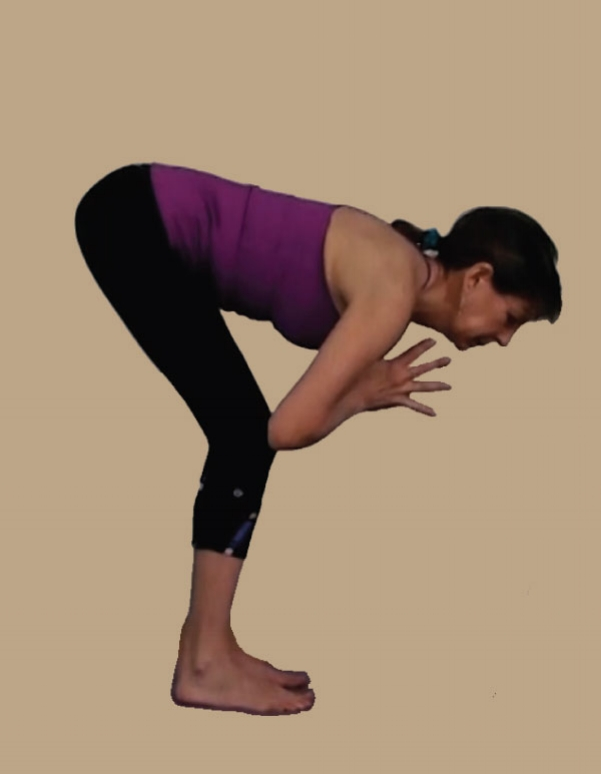
Forward Fold Realigned

In the second picture, I am bending my knees and sending my hips back slightly. This prevents stress on the SI joint or rounding of the lower back. Sending the hips back lets the bony points on the top of the pelvis tip forward slightly. It is possible to overdo the forward tilt of the pelvis. This would create too much arching in the low back (lordosis). Make sure you are not feeling stress in your low back. Imagine you are lifting up a hefty package. The torso can move towards the top of the thighs, and hands might even reach behind the thighs to keep the spine long.

When the knees bend, and the pelvis tilts forward, the hamstrings are slack. Once you have folded over, you can straighten the legs more, creating a stretch in the hamstrings. The knees don’t need to straighten all the way. If you feel any sensation in the knee joint or the knees are hyperextending, soften them. This keeps the ligaments of the knee joint from being overly stretched.

Your hands may come to the tops of the thighs or your shins. You may even place your hands on Yog blocks if they don’t reach all the way to the mat. The goal is to keep the hands high enough so the low back does not need to round.

Once you are forward, the back muscles can relax, and the chin can drop toward the chest. This creates a stretch along the spine and the back of the neck.

To come up, keep the hips back slightly, and let the knees soften or re-bend, drawing up along the spine with the center of gravity over the heels so that the spine is not compressing on the front.

Try this out and see if you can feel the difference.


To see this practice in motion, check out my post

Yoga Realigned – Forward Folds

Yoga Props for your perfect practice

Yoga Props for your perfect practice

Yoga props are not just for beginners

Find out how props can help you create your best practice.  Yoga props are anything you bring to your mat to help make your practice safer and easier on your body, especially your joints.

Props can help keep you feeling balanced and act as an extension of your arms and hands.  Props can protect your spine, seat, or knees.

Props are used by even seasoned yogis who wish to make their practice safe and comfortable.

I use blocks, blankets, bolsters, and a chair in this video. If you are using a chair, place it on your yoga mat or a rug that does not slide.

The goal of yoga is to avoid injury. If any part of a practice creates pain or discomfort, reposition yourself or completely stop the practice.

The video is about three minutes long. If you would like to read more about how to use props in your practice, check out my post, Yoga props- not just for the beginner.

Yoga Props – Not just for the beginner